
Instantaneous and average levels: RMS, LU, LUFS
One of the hardest parts of the Audible technical requirements to meet is the “average RMS” specification – which says that each file, i.e. chapter or section, should average an average level of between -23dBS and -18dBFS RMS.
Let me save you the trouble of googling where you can buy a plugin for your DAW that measures average RMS. There isn’t one. The entire audio industry, apart from Audible, moved on from this years ago and now measures loudness using Loudness Units, or LU (or LUFS).
I won’t go into the technical details of LU or the slight mathematical difference between it and RMS here* but the good news is that measurements you’ll get from a loudness meter plugin are broadly similar to what an average RMS meter would have given you.
The bad news is that “broadly similar” is not enough to guarantee that audio which looks right measured in LU will be actually be right when Audible’s own systems measure it. We will look at this in detail in a later article.
Loudness definitions
One LU – Loudness Unit – is roughly equivalent to one dB. The difference (called K-weighting) is acoustic simulation and weighting that more closely approximates how the human ear perceives loudness than just raw electrical level*. K-Weighting is an international broadcast standard.
Like dB, Loudness units are relative (unless you’re talking about a range) so we append FS in the same way. dB readings are always instantaneous; they refer to the level at that instant.
- “Instantaneous” or “Momentary” LUFS refers to the loudness averaged over the past 400mS (0.4 seconds)
- “Short term” LUFS refers to the loudness averaged over the past 3 seconds
- “Integrated” or “Long Term” LUFS refers to the loudness averaged over the entire playback
- LU range refers to the overall dynamic range of the playback
These are all useful readings to have. Integrated LUFS is the one that’s equivalent to Audible’s “average RMS”. Since Audible’s average RMS spec is -23 to -18 dBFS, this is equivalent to an LU range of 5.
Measuring Loudness with a plugin
Here’s an example of a plugin you might use in your projects. It’s the eminently affordable Waves WLM meter:
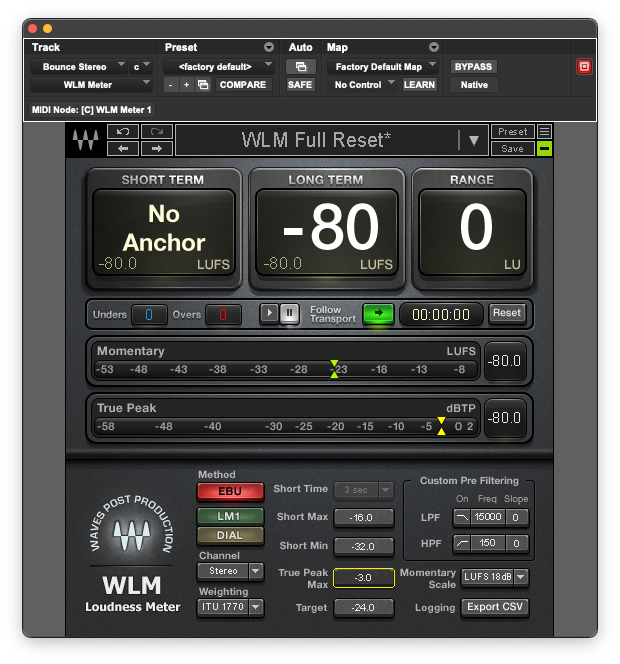
Long Term LUFS is what’s equivalent to average RMS. Let’s see what WLM shows while we’re playing some audio:
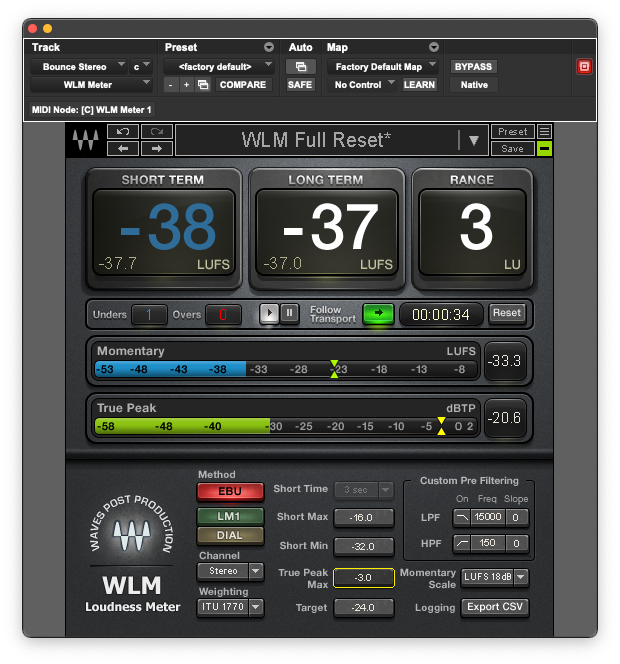
In this screenshot, we can see that the
- instantaneous/momentary LUFS is 33.3 LUFS
- short-term LUFS is -37.7 LUFS
- Integrated/long-term LUFS is -37.0 LUFS
Handily, WLM is also showing the peak level – in this example, it’s -20.6 dBFS.
Getting into the Audible pocket – Don’t forget to reset
To get an accurate Integrated LUFS reading, we need to reset the meter (there’s a reset button just underneath the Range window), and play the chapter from end to end. If you forget to reset the meter, it’ll be showing the integrated LUFS for everything you’ve done since you started work this morning.
The result is this:
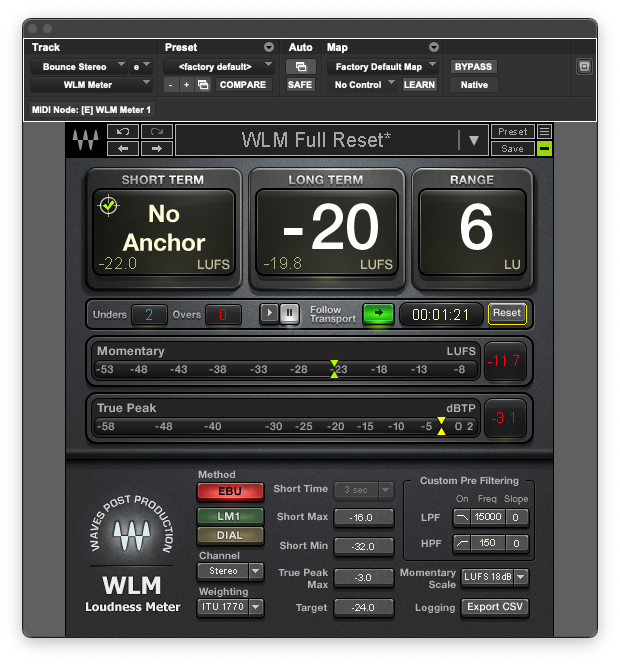
The chapter had a integrated LUFS of -20 LUFS and peak of -3.1 dBFS. It should pass Audible.
Why you need to care
All modern DAWs have pretty comprehensive metering built-in, but this is generally instantaneous dBFS. You need to meter loudness. Waves’ WLM is only one plugin. There are a number on the market depending on your budget and your level of OCD. Another two that I use are Process Audio’s Decibel, and the Youlean Loudness meter.
It’s very useful to have a loudness meter running while you’re actually recording. This helps you keep an eye on how loud you’re speaking. Most narrators, even the pros, get quieter as they get tired towards the end of a day. And most non-professionals tend to speak louder immediately after punching back in after a mistake. Be aware though that metering plugins do put a little extra strain on your computer’s processor – but that’s a conversation for a later article.
<<back to file formats and bit depths
*I do try to resist my natural tendency to get over-technical and indulge my love of facts and figures. If there’s something you think I should go into more deeply, drop me a line or write a comment.
Justin Hill has been in the recording business for more years than he likes to talk about but has traded as The Other operation since 2013. In early 2020, just as the COVID lockdowns started, he decided to build a dedicated spoken word studio.
Despite materials and equipment suppliers either being closed or having no stock, and delivery drivers being unwilling to come to the door, Landen Park Studio actually got finished and had its first session in August 2020.
Since then, Landen Park Studio has recorded countless audiobooks and hosted countless voiceover sessions with Justin Hill at the helm. Many of these audiobooks have been self-narrated by authors who’ve never recorded an audiobook before.